All articles
Finance September 2, 2026 7 min read
Adoption of Stablecoins
Can Stablecoins become the new currency?
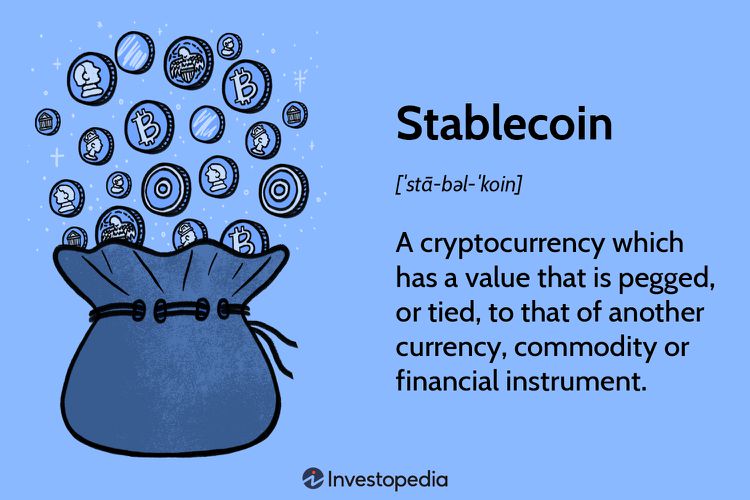
Decentralised Finance (DeFi) is an extremely interesting field that is developing rapidly. I came across this article on Stablecoins, which are essentially digital tokens tied to an underlying asset, such as fiat currencies like the US dollar. I took down the key points, did my own research to understand more about their nature, and came up with answers to 3 important questions related to this article.
Key Points
- 21 financial institutions are coming together to create a company to issue a stablecoin tied to the US dollar.
- Notable firms include Citi, Deutsche, Goldman and Bank of America.
- The group was first announced in October 2025 with just 10 banks, but the current plan is to release the coin in the first half of 2027.
- The plan is to further expand into G7 currencies, with the euro as the priority.
- Stablecoins are mostly used for crypto trading, but their price rebound in 2024 and Donald Trump’s support for the sector revived interest in using blockchain as part of the mainstream financial system.
- They face competition from another group of 37 financial institutions called Qivalis, which is planning to launch a euro-pegged stablecoin later this year.
- Some banks, like BBVA, are part of both groups.
- Trump’s family crypto business, World Liberty Financial, has also issued its own stablecoin.
- There are some signs of demand for stablecoins issued by banks.
- The stablecoin market is currently dominated by Tether, which has issued more than $180 billion of its dollar-pegged token.
- The profits come from investing the reserves in assets such as US Treasuries.
- France’s Societe Generale was the first major bank to issue a dollar-backed stablecoin, but it has not been widely adopted, with only $12.5 million in circulation.
- This bank is not part of either of the groups mentioned above that are coming out with stablecoins.
- European Central Bank President Christine Lagarde has warned that privately issued stablecoins pose risks to monetary policy and financial stability.
Background Research
- Stablecoins are considered stable because they are less volatile than traditional crypto like Bitcoin
- They are pegged to fiat currencies (traditional government issued money), commodities, or financial instruments
- Less risky for everyday transactions - A seller who is paid in crypto doesn’t want that payment’s value to suddenly plunge in the next few hours
- Uses of stablecoins:
- Provides liquidity for trading assets
- Exchanges (centralised and de-centralised) - Can use for trading, financial services, or converting between stablecoins
- DeFi protocols - Peer to peer transactions without intermediaries
- Infrastructure protocols - Bridges between different blockchains require stablecoins on one chain to be locked so that others on another chain can be freed
- Payments
- Can be peer to peer, consumer to business, business to business, or business to consumer
- Transfers
- Movement of stablecoins for non-payment purposes, such as corporate treasury management
- Idle
- Stablecoins just sitting in wallets, notable point is that some may be inaccessible due to loss of keys
- Estimated Distribution of stablecoin usage:
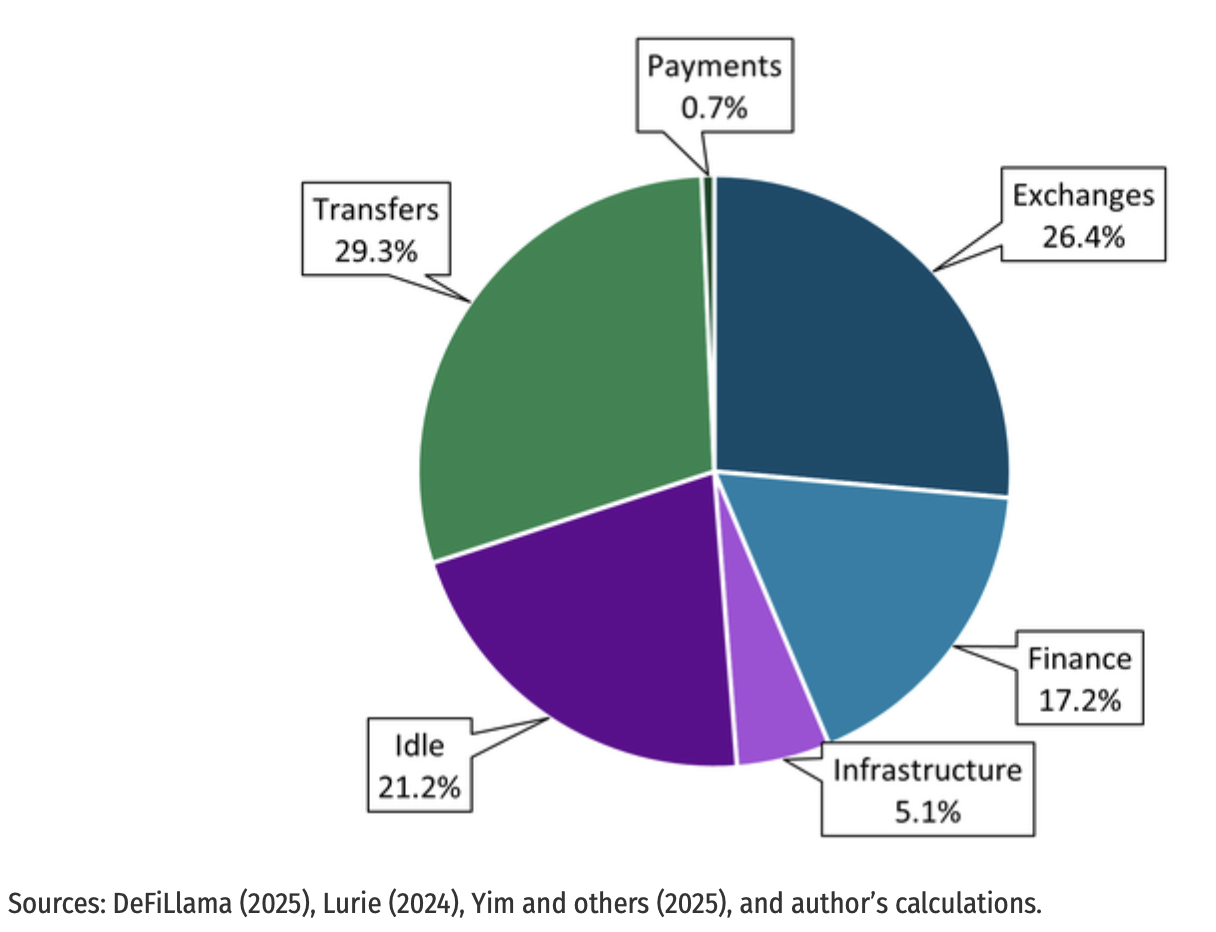
- Very rough estimate from source, and was done in April 2026
- Provides liquidity for trading assets
- Demand for stablecoins:
- Global workers are driving demand because they are upset with fees and delays of traditional cross-border payouts
- The trend is that the rate of people willing to accept stablecoins as payouts outpaces the current adoption rate
- Stripe’s report is that 57% of more than 2300 independent workers surveyed across 20 countries would be willing to accept stablecoin payouts
- Especially in emerging markets, stablecoins help with protecting against their local currency inflation and also providing access to US dollars
- These workers want high yields on their balances, education on how to deal with stablecoins, and simple digital wallet setup to reduce friction
Important Questions
- Will demand for stablecoins grow?
- Demand is clearly there in emerging economies, because these coins provide more certainty and access to a better currency
- If the inertia is to do with setting up systems, companies like Stripe have already tested their own implementation and found that 90% of respondents are willing to use their wallet software which can overcome that friction
- Speed and reduced fees is a real benefit, and the removal of intermediaries can also entice more people to shift towards stablecoins
- Trump’s support for crypto has contributed to a more favourable and predictable U.S. regulatory environment for digital assets, which could continue to support growth across the sector
- Demand for the coins hinges on people’s knowledge on how they work and benefits over traditional currencies, such as higher yields which may not be promised
- A large portion of stablecoins seem to be idle right now, and payments are also making up a very small proportion of them. Hence, the drivers still remain very much within the crypto ecosystem itself, and mainstream demand may lag.
- How successful will this initiative be?
- For now, Tether dominates the market for US-pegged stablecoins and it may be hard to capture market share from them, but ventures to issue stablecoins tied to other currencies or commodities are well on the way and could provide another route to entering the market
- Major financial institutions are already trusted by millions and they have established distribution channels. If they band together to form this collective initiative, it is likely that many would participate in it after understanding the value proposition
- Current data indicates that stablecoins are still largely tied to crypto systems, and the proportion of it used for merely managing infrastructure of these systems shouldn’t be underestimated. If the aim is to establish a payments-focused stablecoin, it may require significantly greater adoption and liquidity before it may be successful
- The limited adoption of Société Générale's stablecoin could indicate that institutional credibility alone is insufficient to overcome users' preference for established issuers, although this may also reflect weaker liquidity, network effects and integration
- What are the broader implications for the financial system?
- There are benefits which include instant settlement of transactions and financial inclusion of emerging markets through digital dollars
- There are also banking and monetary risks:
- Migration of deposits into private tokens means less lending capacity + potentially rising bank funding costs
- Local currency sovereignty is threatened in emerging economies if many swap domestic tender for digital assets
- There would likely be an increased demand for short term US T-bills to be used as reserves for stablecoin issuers, which would then drive up the prices of T-bills (translates to lower borrowing costs for US government, lower yield for buyers)
- Regulatory and Financial stability concerns:
- Changes in the crypto market poses a significant risk to traditional markets - Issuer will need to rapidly liquidate their reserve assets if there is a sudden wave of user redemptions, which could mean billions of T-bills are liquidated at once and this disrupts the short-term funding market
- Enforcement is challenging because public blockchains are borderless and pseudonymous
- Regulation is still not well defined on these digital assets - a stablecoin is still being debated as to whether it is a banking product, a payment system, a commodity, etc.
Sources
- https://www.reuters.com/business/finance/goldman-sachs-bofa-others-plan-issue-dollar-stablecoin-together-2027-2026-09-01/
- https://www.kansascityfed.org/research/payments-system-research-briefings/what-are-stablecoins-used-for-today-estimating-the-distribution-of-stablecoins/
- https://www.investopedia.com/terms/s/stablecoin.asp
- https://stripe.com/blog/why-global-workers-are-driving-demand-for-stablecoin-payouts
- https://www.bis.org/publications/working-paper-1363-macroeconomics-stablecoins
#Crypto#DeFi#Finance